Here is what you will find in this awesome guide:
- Part I: The Publishing Process
- 1. Books and Manuals
- 2. Manuscript Preparation, Manuscript Editing, and Proofreading
- 3. Illustrations and Tables
- 4. Rights, Permissions, and Copyright Administration by William S. Strong
- Part II: Style and Usage
- 5. Grammar and Usage by Bryan A. Garner
- 6. Punctuation
- 7. Spelling, Distinctive Treatment of Words, and Compounds
- 8. Names, Terms, and Titles of Works
- 9. Numbers
- 10. Abbreviations
- 11. Languages Other than English
- 12. Mathematics in Type
- 13. Quotations and Dialogue
- Part III: Source Citations and Indexes
- 14. Notes and Bibliography
- 15. Author-Date References
- 16. Indexes
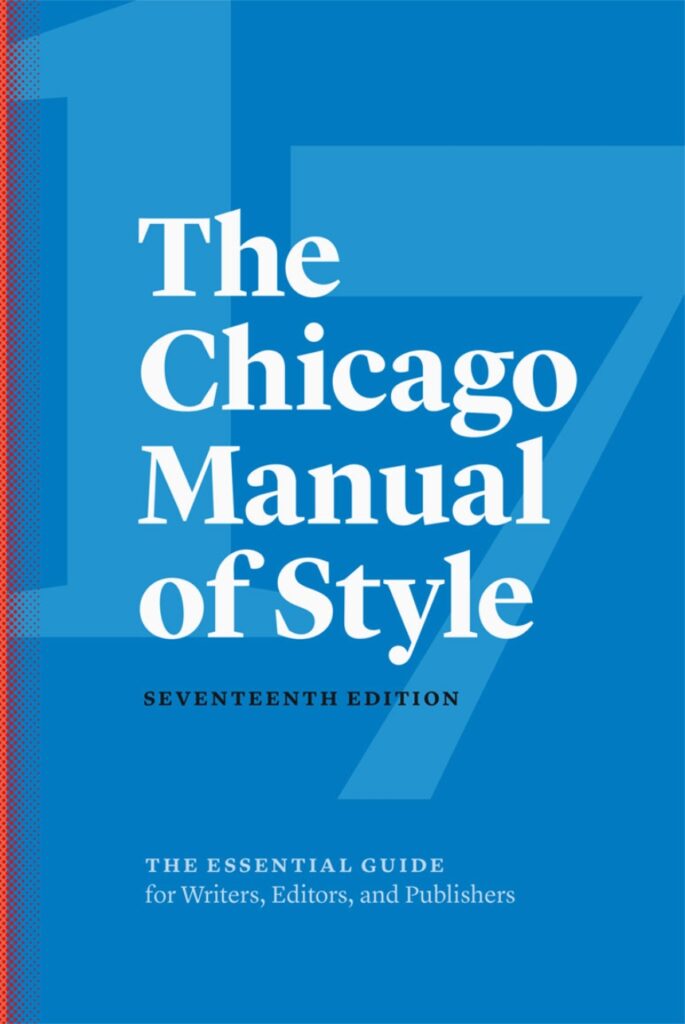
The Chicago Manual of Style is an American English style and usage guide published continuously by the University of Chicago Press since 1906. Today, it is used widely in many academic disciplines and is considered the standard for US style in book publishing.
The Manual is now in its 17th edition, published in 2017. Sometimes referred to by its acronym, CMOS (pronounced like “sea moss”), The Chicago Manual of Style is available both in print and online, for an annual subscription fee. A free Chicago style Q&A and other resources are also available to the public on the CMOS website.
Grammar enthusiasts celebrate “Chicago style” rules, such as whether to put the title of a book in italics (Chicago style says yes, whereas AP style recommends quotation marks), or whether to use a serial comma—also known as an “Oxford” comma (Chicago style: yes; AP style: no). However, the editors at the University of Chicago Press acknowledge that rules are often context-dependent, and sometimes need to be broken. The Manual is thus also respected for its flexibility.
The Chicago Manual of Style has become a staple reference for writers and editors, in part because it was one of the first style guides to be published in book form, and the only one from an academic press in North America. (Other style guides are published by professional associations.) Eventually, the Manual became a canonical work synonymous with its home institution, akin to the Oxford English Dictionary.